DSO leaders answer questions on associate ownership, recruitment, mentorship and more in a roundtable discussion
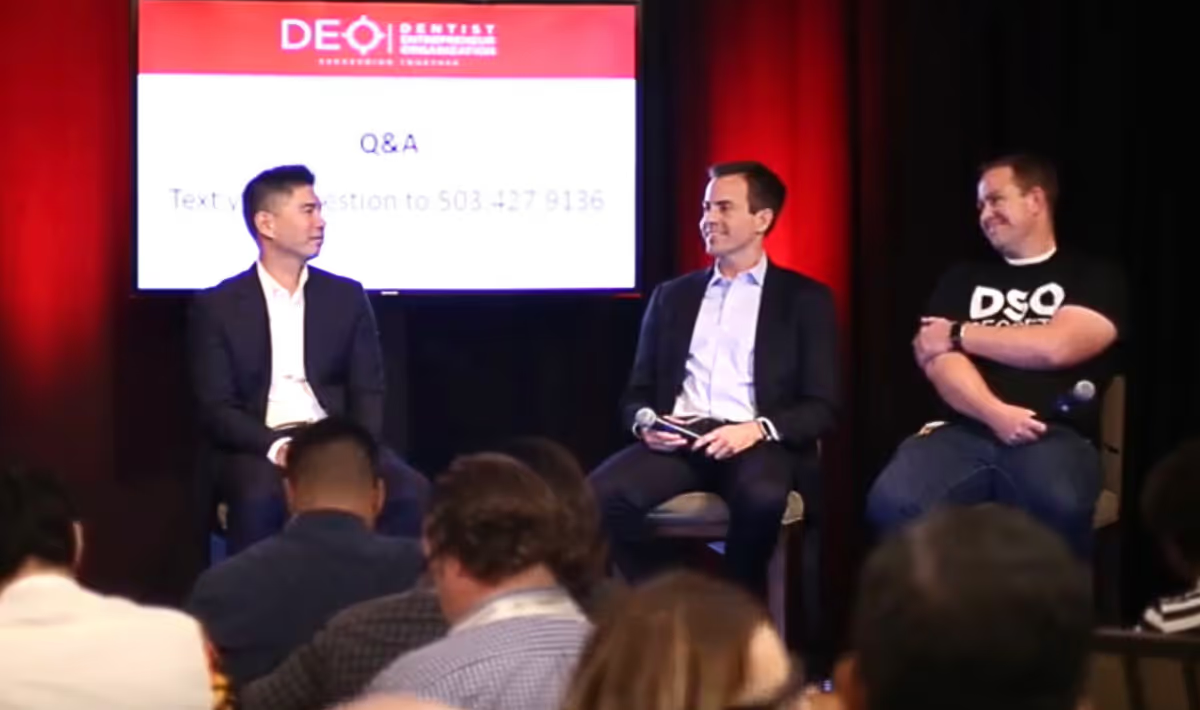
The DEO: Dentist Entrepreneur Organization, a community for dentists growing group practices, held a roundtable discussion at their Summit on How to Create a Winning Culture with Associates with Dr. Richard Evangelista, Justin Puckett and Emmet Scott.
Dr. Richard Evangelista is a dentist based in Fremont, Calif., and is the founder and CEO of Dentalforce, a dental management and growth consulting company educating, coaching and supporting dentists at each stage of their careers. Dr. Evangelista grew his own group practice from five locations and 30 employees to more than 40 locations and 400-plus employees in five years.
Justin Puckett is president of MB2 Dental and has a unique background in corporate finance, public accounting and corporate law, providing that knowledge base in assisting doctor entrepreneurs evaluating their growth capacities. Dallas-based MB2 Dental partners with hundreds of dentists across the U.S. as a dental partnership organization. Its model creates dentist-owners in private practice who can compete with larger dental groups while maintaining control of their practice from a clinical and non-clinical aspect.
Emmet Scott is president of the Association of Dental Support Organizations (ADSO) and co-founder and CEO of Community Dental Partners, based in Denton, Texas, and Smile Magic Dentistry and Braces, a Chuck E. Cheese-like dental practice for kids. He is the host of DSO Secrets, a podcast for emerging dental support organizations. Community Dental Partners was designed by dentists for dentists who recognize the need to partner with responsible business experts.
DEO: Dentist Entrepreneur Organization (DEO): There is a certain culture of openness in our industry, and it makes these conversations very exciting. Associate ownership is a big topic. True or false, going forward DSOs will need to offer ownership to doctors to retain them?
Dr. Richard Evangelista: False. Look at Heartland. Heartland really doesnt have ownership. They have some stock options. So, theres ways to keep dentists and it just depends on the dentist. When youre recruiting, youll find dentists who are very entrepreneurial who want their own thing and youll find some that dont want any part of it. But I think it can succeed and I offer ownership in my practices.
Justin Puckett: I think its false, even though we offer ownership. You need to make it a career for them. We believe thats through ownership, but you dont have to offer it.
Emmet Scott: You must know your model. Everything in my world is going to end in some experience-based level or some type of commoditization. If I have a model where I want to build around 9-to-5 part-time dentists and pay them a salary, then I probably dont need to worry about an ownership model.
But if I want to bring someone in whos looking for extended hours, production and bringing patients to the next level, then Im looking for a personality type that wants ownership momentum. You just must know which model youre driving towards.
DEO: Do you all recruit entrepreneurial dentists?
Scott: We do. Its kind of like catching a lion. Youre thrilled but then you must figure out what to do with them. We target the motivated, entrepreneur dentist. Well interview 10 to get to one that fits us culturally. Our model is to hit the entrepreneur buttons, and ownership is one of those buttons.
We try to hit many buttons. Were attracted to candidates who want a set salary right out of school and a potential to make as much as possible. They also want their debt paid off along the way and structured on production, not collections. We try to hit each one of those buttons and then give them a partnership.
DEO: Those wants can be annoying. What causes you to approach those differently and seek them out?
Scott: Language is important. When I hear someone say, Im a group practice, or Im a multi-practice, I think the problem is theyre missing who their customer is. And their customer is yes, patients, but if theyre going to scale at all, its the dentist.
As a DSO, my job is to figure out how to support dentists and what their patients are interested in having. They tell me what the specs of the product they need looks like and Im adjusting to what they want. For me, instead of thinking of it as annoying, I think of it as knowing what my customer wants. If I create the perfect product, then theres a waiting list for dentists to join.
Dr. Evangelista: When a dentist comes in now, theyll bring notebooks of questions to ask you during their interview. Do they get a daily rate? Theyre coming out of school and they want to know how theyre going to pay their student loans. Thats their number one concern.
The second thing they look for is percentage. Whats my percentage? Whos going to mentor me? How much CE do I get? You must have answers for those questions because there are other corporate offices where they could get a job that have those answers down. So, how do you paint a picture to make them want to join your company?
Puckett: As youre growing and have no money and are extended, you have to offer something different. You know you cant compete with Heartland. Were in different places. Were in El Campo, Texas. Were in Alaska. You have to offer more, and it cant always be a higher percentage.
Why are you joining us? It must be a career and not just a job for two years to pay your student loans.
DEO: What do you do with someone who wants to run their own practice?
Puckett: We have a path to ownership. About 80% of our owners have come internally. In our model, they cant buy into their own store, but they can find a new store, which we will help them buy. Our owners own multiple practices, and we offer an opportunity for every dentist to invest in the whole company as well.
How do you get the doctor in Alaska to care about the doctor in Beaumont, Texas? Even as an associate, we pitch the opportunity to invest alongside many and diversify your risk and wealth.
DEO: How do you look at training programs for your associates?
Dr. Evangelista: One of my ways of retaining dentists is through a mentorship program. It gives them someone to rely on and ask questions to. If you want to retain an associate, you must put them through some type of learning situation. They want to stay because theyre learning every day. People want to stay to get better. We create an avenue where theyre learning every year through CEs, bringing in speakers and mentorships.
About six or seven senior doctors are in the mentorship program and they travel to the less experienced doctor and work over their shoulder on those days.
Puckett: Our organization was founded because they had bad experiences of being overtrained. Associates want to learn. In our model, most of the training is done by the owner of that brand. Every office is different. We try to assist on a global level with the common things. About half of the time, it may not even have to do with dentistry.
Its leadership. Its things as simple as how do I get a mortgage if Im $500,000 in debt? Thats something we would have never thought about, but in talking to our associates, its something they want to learn. Were building a base of knowledge outside of the clinical side.
Scott: We have a platform called the Ultimate Dentist and professional groups that are basically mastermind groups. We divide the dentists out into groups of five to seven dentists, not from the same practice, and they meet every six weeks through a webinar to talk about different topics.
When developing training, its important to be cognizant of whats obvious to you. You must remember who you were before. And if youre a natural leader, youll have more of a challenge creating a training program. You need someone else on your team to help build it out because for those that it comes naturally to, its almost like asking tell me how you breathe.
You need to be able to document how you do what you do and make it scalable. Thats a big challenge to hand it off to someone else.
DEO: How do you offer mentorship to associates who are scared to run their own practice?
Dr. Evangelista: Finding doctors isnt easy. Everyone that comes out of school is freaked out. When a doctor comes in, its important to ask what they really want out of the position. I have a doctor work in a practice with either one of my senior doctors or a clinical director. After that, it hasnt been a big issue. Most doctors are ready to go. They have so much debt that theyre ready to go.
DEO: What do you do when recruiting doctors from other states who dont have a license in your state?
Puckett: We have offices in different states. Someone in Alaska isnt coming to Texas. But if youre recruiting an out-of-state candidate, they can come observe. But youre never going to know how good clinically they are in a working interview. Its an interview. Theyre on their best behavior and fully focused. Many times, it goes back to personality and how theyre going to handle problems when they arise.
Dr. Evangelista: It just sucks. You just dont know. The truth is youll never see their bad patterns until they start to show them. They always show up in that three-to-six-month period. Your working interview means nothing, and your first few weeks mean nothing. Im recruiting constantly.
DEO: Whats your process when those bad patterns start showing up?
Dr. Evangelista: I fire them. Theyre gone. I have no problem firing. Its not worth your time to put up with that doctor if theyre not willing to be nice and not willing to learn. Move on.
Puckett: For us, its dependent on the owner. Different ones have different patience levels. A lot of it is managing expectations. We arent a good fit for a doctor who wants to work three days, make $250,000, never get an email, dont call him after 3 p.m. and wants three RDAs in one room with him.
Manage it up front. This is what our office is like. This is my belief in this. Are you a good fit? If not, then no harm, no foul.
Scott: Im playing the long game. If a dentist isnt working out, then the first thing I assess is where in the system did I miss? I want to improve a long-term system. If the dentist is humble, I can solve 99% of the issues. So, on the front end Id rather get a humble dentist than any other skillset.
Many times, they struggle with their people skills. But if theyre struggling on the clinical side, theyre feeling stress and that starts to roll over to other areas. If I help them there, then that can relieve some of the stress. Then I can layer some of the other leadership and communication things to help them get to the next level.
DEO: Many successful businesses have the philosophy of hire slow, fire fast. But how do you handle the patients when you fire a doctor?
Dr. Evangelista: Hire fast, fire fast. Im always hiring. If ones not working out, I already have another ready to go. Patients are always going to be taken care of. Thats never our issue. Our issue is holding on to a dentist too long. And we dont have many humble dentists in California.
My attrition rate from losing a doctor is about 5%. Patients are creatures of habit. They want to go to the same place.
DEO: I think what youre seeing here is different business models based on the variants they have. Theres no right way to do a DSO.
Puckett: The answer is also dependent on where the office is. People from the Bay Area look at it like a commodity. People in Missouri will react differently to seeing multiple dentists in one office. Its a different conversation and youre training staff differently. You better have a good staff in that scenario. For most patients, healthcare is still a neighborhood service. So, they want someone with a familiar face.
Dr. Evangelista: I wouldnt say that. In my offices, theres a certain culture which I try to create. When I onboard a dentist, I make sure that he understands hes going to be the top 1% of dentists. Hes coming there to work. I let them know right away that this is not doing some fillings and going home. My patients know that too. When we lose a doctor its because that doctor isnt good enough.
DEO: Is there a production hump that associates struggle getting over?
Dr. Evangelista: We set our goals for every doctor at $5,000 a day and thats the hump that seems tough for new graduates. But we set it there to make overhead.
We track a lot of numbers. We track treatment prevented and treatment accepted. Most doctors dont realize that their treatment acceptance rate is bad. Even good doctors are only around 70%. So, if they must hit $5,000 a day, they must diagnose $7,500 a day. And forget a new doctor diagnosing $1,000 on every patient even if they see eight patients a day. Its tough, but they get over it through training. Its important to have a training program to get them to see what theyre missing.
Puckett: Every office is a different hump. We ask every associate their goals. What are they trying to make? What is their personal goal? People are all over the spectrum. But showing them the data is a start. If they want to make this, then they need to see this number of patients. A doctor-to-doctor conversation is important here.
Most of its confidence. Does the associate have the confidence to close the case? Can the associate work with staff and the treatment coordinator? Is the patient scared of financial ramifications? All of that is training and most of it isnt clinical.
Scott: The production hump depends on the fee schedules that youre working against. It can be different. For us, our worst dentist hit $3,000 a day and then the next group was at $6,000 a day and our best have a hard time getting to $7,000 or $8,000 a day consistently.
So, what facility constraints start to creep in? Not all of it is a clinician needing to be better. Whats the staffing support? Where is your system starting to break down? You need to break it down step-by-step in training so you can duplicate success across offices.
McDonalds has figured out how to get 16-year-olds, who are thinking about their girlfriends, to cook raw meat and not kill 1 billion people. So, theres a system that theyve had to think through. A lot of us would just say, cook the meat. But its not that simple.
There are nuances to figure out when training others. Many times, we end up mentoring dentists by saying, you went through dental school, its not that hard, just do what I do and produce like I produce. That doesnt work.
For the clinicians out there, you must sit side-by-side with your dentists. Many dont take the time to do that. Look at photos and X-rays with them and ask them what theyre seeing.
Puckett: It goes back to spotting ego early on. If theyre not coachable or not willing, then you know the result and youre just delaying the inevitable.
DEO: How do you keep enough opportunities in front of entrepreneurial dentists to make sure they dont go out
on their own?
Scott: I think thats the responsibility of you and the organization to have something sweet enough. Im not going to trap someone into being a partner. If you lose a great dentist, figure out what you could have done better to have made it sweeter for them to stay.
Dr. Evangelista: Ownership models. We offer buying into our office. We started at 49% but flipped it to 50% because it sounds better to a doctor. Theres no real difference other than 1%. We put them on a path to ownership like everyone else and its up to them whether they want to take ownership.
Im in a different market. My associates come out of school with advisors already. Theyll say they need to talk to their advisor. A lot of them dont want partnership models, but they want the whole thing. So, we give them that choice to buy their own practice. We help them buy, we locate it for them, and we manage it.
Puckett: For us, its important theyre motivated on a local level but also on the parent company level. We want them motivated on both levels. You can invest alongside everyone.
DEO: What are some creative ways to attract associates to rural locations?
Scott: When youre getting entrepreneurial dentists, they already have a bigger vision. So, they want to own that town. Youre playing off the momentum they would already bring.
You also must get the spouse to buy in. Weve created marketing materials to promote those areas. Something like, everything in Texas is within 12 hours of the beach.
Sometimes the associate just wants to make a good amount of money and be able to pay down their student loans, and then do a partnership program with us. So, it starts to become part of the bigger career. We have a lucrative package to pay down student loans. You must be creative and find the right fit.
Puckett: Its tough. We have 26-year-olds and Im trying to convince them to go to Victoria, Texas. You must sell them on a larger vision of you can come here and make a lot of money. That its a little less competitive. They can open four practices near each other and travel every weekend. Theyll have money and they can fly to Houston or Dallas.
Rural practices have more difficulties, and you must sell them on why theyre moving there. But if theyre angry moving there, eventually youll have the same problem.
Dr. Evangelista: Rural is very relative if you live in the Bay Area or San Diego because rural is only 30 minutes away. We have the same problems too even though we have a lot of dentists. Its hard to get dentists and you must paint a good picture. Napa, Calif., even though everyone thinks its great, is hard to recruit to. We must recruit out of state for that. We send them everything from Napa showing them what its like to live there.
DEO: Are you able to sustain a consistent culture in all your offices despite the diversity in associates and owners? How much emphasis is placed on culture and training when you take in a new doctor?
Puckett: Our owner group is very diverse. We have LDS guys with eight kids. We have single guys that hope to never get married. We dont have the same culture across all our offices because we have different human beings as owners. But the one thing we try to create is the why are you here and why are you joining other people. You need to invest in other people so that you care about them.
Scott: We have nine pillars, but I didnt want to have nine pillars that nobody looked at. Figure out what your values are and how youre going to make them a recurring action.
Gratitude is a big one for us. How do you drive gratitude? We put up a board at each office and we want associates to write on sticky notes something theyre grateful for about somebody else in the office. They put their colleagues name on the front and their name on the back. In the weekly staff meeting, we put those sticky notes in a bag and draw one out. Whoever gave the gratitude statement and whoever got it, they each win a gift card.
Just think of creative ways to commit to culture and drive it. Those little things make a huge difference.
Dr. Evangelista: I dont believe in culture. You can preach culture all you want, and the truth is you tell them, this is who we are, and this is what we do, and everyones hooray, hooray and then half an hour later theyre back to business.
I have just one goal. No matter what youre doing, youre just getting better.
Scott: Im not your culture, just so you know.
Dr. Evangelista: I just dont believe in preaching it.
Scott: It must be authentic. Dont do something thats not you. Thats unsustainable. If your personality drives you a certain way, youll naturally attract people who align with you.
DEO: Take us through a conversation with an associate whos underperforming. How do you boost them to the next level?
Scott: Why are they underperforming? Are they bad with patients, with staff or with their clinical skill? Youre going to take those on one at a time. So, if the staff likes them but the patients dont, then case acceptance is low. The dentist must want to increase their production.
If theyve already treatment planned it, but the patient isnt accepting it, theres a skillset missing. Either the doctor is missing it, or the system is missing it. Maybe it isnt the dentists fault but its the treatment coordinators fault. Where is the process breaking down? In an ideal situation, I bring over resources from a successful practice to help.
Puckett: Most of the time, its a clinician conversation. But every conversation is going to be different. Thats when talented owners excel.
Dr. Evangelista: For clinicians, there are only two reasons they dont produce. One, they dont know how to treatment plan. Two, they dont know how to communicate.
Ive tried to build systems in communication that help a doctor communicate to the patient. I have bullet points of what theyre supposed to go through clinically. I give them a certain amount of time to treatment plan. They know what to look for and dont talk too much.
We work on that more than the clinical side. The communication is usually the issue. Patients just dont believe new dentists.
Share this post