The Question Every Dental Leader Is About to Face
Every AI vendor in dentistry is promising the same thing right now: faster claims processing, cleaner verification, and less manual work. The pitches are polished. The demos are impressive. And most of them will not survive contact with your revenue cycle.
That is not skepticism; it is the data. RAND Corporation found that more than 80% of enterprise AI projects fail to deliver their promised business value, roughly twice the failure rate of conventional software.1 MIT's 2025 research went further, finding that 95% of organizations deploying generative AI saw zero measurable return.2 For dental groups running on thin margins, choosing the wrong AI partner is not a neutral experiment. It is lost time, disrupted collections, and a team that trusts technology a little less the next time.
The encouraging part: the failures are predictable, which means they are avoidable. Researchers at MIT, Gartner, and RAND converge on the same conclusion, the models are rarely the problem. Projects fail because the AI is not connected to real company systems, lacks durable context or memory, and is built for demos instead of workflows.3 Before you sign with any vendor, these are the questions that separate a real partner from an expensive lesson.
1. Does it choose accuracy over speed?
A fast wrong answer is not efficient, it is a denied claim and a fight to get paid. Any tool can demo speed. What protects your collections is what happens in the gray areas: a missing-tooth clause, a downgrade buried in the plan, a frequency limitation that is not obvious.
Ask what the system does when it is not certain. Does it flag the exception for a specialist, or quietly guess and move on?
2. Can your team understand why it made a decision?
If your billing lead cannot explain why a claim was coded a certain way, you do not have a tool, you have a liability. Insist on AI whose decisions are auditable and traceable back to the source. When a payer challenges a claim, you want the answer in seconds, not a shrug.
3. How fast does it adapt when payers change the rules?
Payers change waiting periods, frequencies, and downgrade rules constantly and as one dental leader put it, the insurance company changes the rules while the practice inherits the consequences. An AI trained once and frozen at launch falls behind fast. The right system learns from every payer interaction and applies that learning going forward.
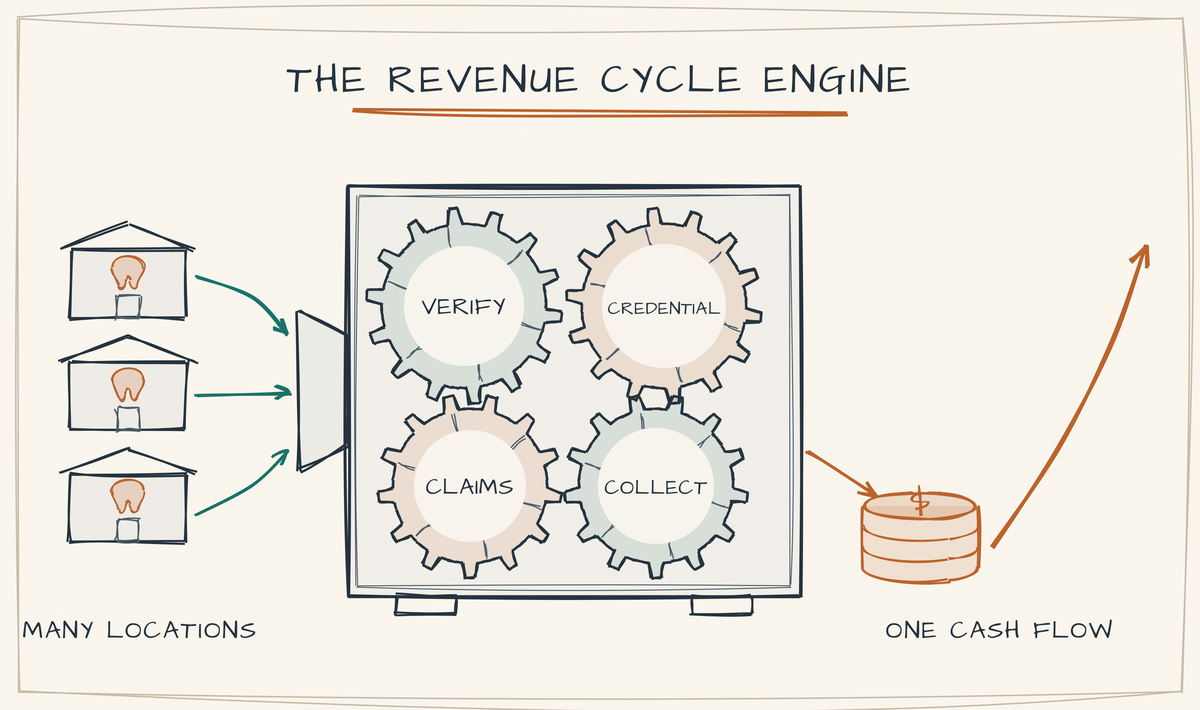
4. Will it scale from one location to fifty?
Growth by adding staff means adding cost, training, and inconsistency at every site. The right technology runs location #1 and location #50 to the same standard, without re-solving the problem each time you expand.
5. Is it genuinely secure?
Your practice handles some of the most sensitive data there is. HIPAA compliance, real safeguards against errors, and clear answers on how patient data is protected are non-negotiable.
The Bottom Line
This decision was never really about automation. It is about trust, accuracy, and stability, and about choosing a team that is still standing beside you when the payers push back. Because the best AI does not replace your team. It helps your team make better decisions, with greater confidence.
Dental-X AI was built to meet exactly that standard, finding the revenue leaking out of your insurance workflow, recapturing it, and proving it back to you in recovered dollars.
To see where revenue is quietly leaking in your own workflow, connect with the Dental-X AI team today.
Sources
- RAND Corporation (2024), The Root Causes of Failure for Artificial Intelligence Projects. rand.org
- MIT Project NANDA (2025), The GenAI Divide: State of AI in Business 2025. nanda.media.mit.edu
- Gartner (2025), Why GenAI Projects Fail. gartner.com

Share this post