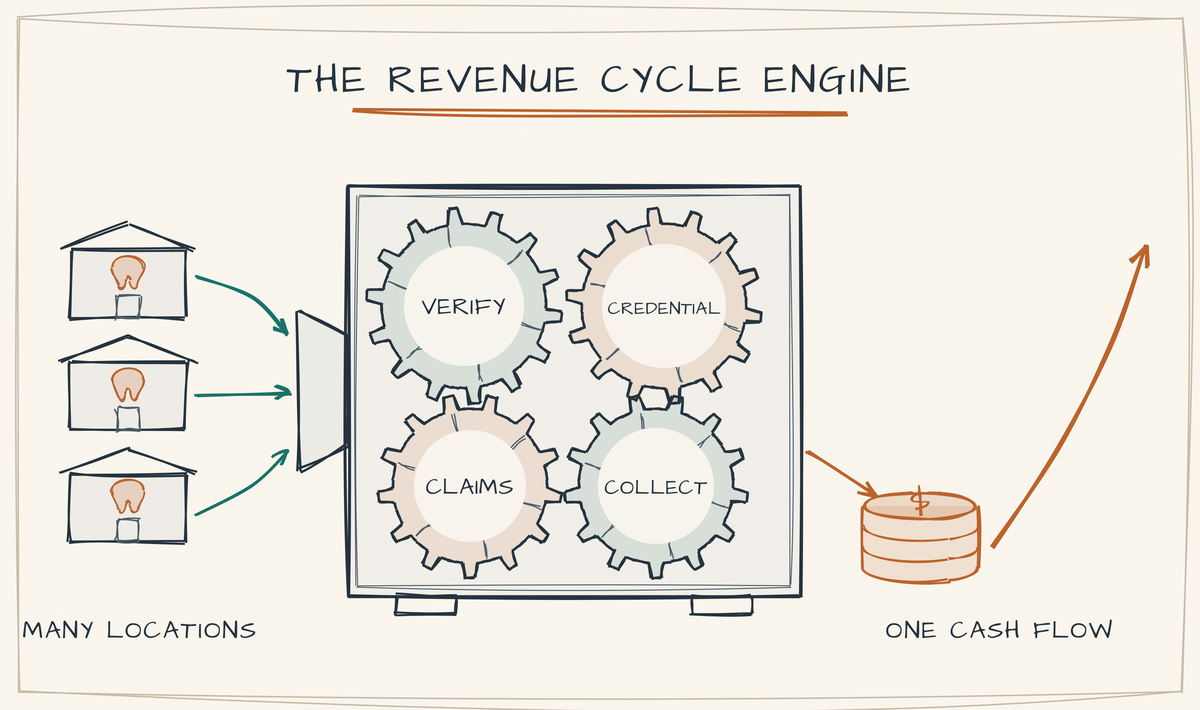
Growth creates leverage and complexity for dental groups. At affiliation, all functions are managed locally, from scheduling, insurance verification, claims, collections, and credentialing. As groups expand, however, decentralized revenue cycle management creates inconsistent processes, duplicates effort across locations, relies too heavily on generalists and limits leadership’s ability to identify and correct problems.
Complicating matters, many affiliations preserve doctor autonomy over administrative decisions that increasingly affect enterprise value. Clinical autonomy should remain with doctors. But payer strategy, credentialing, fee schedules, revenue cycle standards and reporting generally become more effective when managed consistently across the organization.
Therefore, the question becomes not simply whether to centralize, but when to centralize, which functions belong at the corporate level, what can or should be outsourced to specialized partners and which capabilities remain locally managed.
For growing dental groups, the first functions to consolidate are those that are repetitive, apply across the organization and benefit from specialization and scale.
Insurance eligibility and benefit verification and credentialing are great examples. The proper centralized team or third-party partner can organize existing records, develop standardized workflows, install best practices and communicate satisfactory operating expectations and timelines.
Over time, revenue cycle functions should be organized into specialized teams responsible for:
- Scheduling
- Insurance eligibility and benefit verification
- Credentialing and provider enrollment
- Claims submission, management, denials and appeals
- Payment posting
- Insurance accounts receivable and collections
- Patient accounts receivable and collections
- Payer contracting strategy and payer relations
- Revenue cycle analytics and performance management
For smaller groups, the initial corporate structure might consist of a Revenue Cycle leader who owns performance and is supported by a few team members. These employees often know the practices extraordinarily well, but operating a successful front office is a different competency from designing revenue cycle infrastructure across multiple entities, locations, payers and states.
But the revenue cycle controls cash flow. It’s the engine that turns every service into collected dollars that pay salaries, fund future acquisitions and fuel growth.
As a result, the most successful groups make strategic investments early and often into their revenue cycle.
To demonstrate the effectiveness of consolidated revenue cycle decision making, consider a real-world example of 15 geographically concentrated dental practices affiliated over a 5-year period. Each practice maintained its own UCR fee schedule, specific payer contracting strategy and coding and scheduling practices.
While honoring each office’s individuality and doctor autonomy, this structure created a number of easily identifiable anchors to efficient growth.
- Many of the practices used different sources of data and strategies applied at varying frequencies and times to update their office fee schedule. The result was 15 unique office fee schedules that had to be individually maintained and accounted for in practice management systems, treatment plans, EOB audits and fee negotiations. Given the geographic concentration, this also led practices to competing with each on price for the same treatment eroding margins.
- Each practice determined their own payer contracting strategy and negotiated rates on their own or through different 3rd parties. Some doctors chose rate over patient access despite insufficient patient attraction and retention results…and none leveraged the size of the collective group to maximize success.
- An analysis by our team found that most practices had different practices for scheduling and chair time hours per procedure reducing capacity, patient access and visibility into problems.
- Lastly, documentation differences between practices showed real gaps in operations and business intelligence that impaired data-driven decision making for leadership.
Technology must support the centralized model as well. Leadership should have visibility into credentialing status, payer participation, fee schedules, claims, denials, aging AR, collections and performance by location, provider and payer. Without that infrastructure, centralization simply moves fragmented work from the practices into a corporate office.
The strongest growing groups build this infrastructure before complexity forces them to.
For DEO members with access to experienced, battle-tested resources, the opportunity is to combine centralization, outsourcing, technology and specialization into a scalable operating model.
The objective is not to move every administrative function to corporate headquarters. It is to place each responsibility where the organization can execute it most consistently, efficiently and profitably.
Learn more with a Discovery Session with Five Lakes by visiting www.fivelakespro.com
Share this post