Why Isn't My Dental Marketing Working? Fix Your Funnel Before You Switch Firms

One of the biggest complaints I hear from dentists is about their marketing firm. They want a better one. They've switched firms multiple times. And they're still not getting the results they wanted.
I want to walk you through how to get three and a half times the results from the marketing firm you already have, or know when it's time to switch and still get that return.
Why isn't your dental marketing working?
Most of the time, it's not your marketing firm. It's the leaks further down your marketing funnel: phone calls that never get answered, patients who say no to treatment, and procedures that don't match what your community needs. Fix the funnel from the bottom up, and the same leads from the same firm can turn into three and a half times more patients saying yes.
Why marketing seemed to work when you first opened
When we first start a practice, we hire some kind of marketing firm, or spend very little on marketing, and we think about it like this: I do marketing, patients come in, and then we do treatment.
For some of you, that actually worked. And that's the problem. It gave you a false positive on how to build the business.
Anytime you start at zero and get something, it feels like progress. Your schedule was wide open. You had very few patients, so you were hyper focused on the ones who came in, and their experience was probably great. Your mind says, "Hey, this business is working."
So we just keep doing it. But that's an immature approach to a marketing funnel. What I want to show you is the executive approach.
Stop saying marketing. Start saying marketing funnel.
When the numbers aren't there, most owners say, "Something's wrong with our marketing." I want you to change that sentence. Say, "Something's broken in my marketing funnel. I'm going to start from the bottom, and I'm going to work my way up."
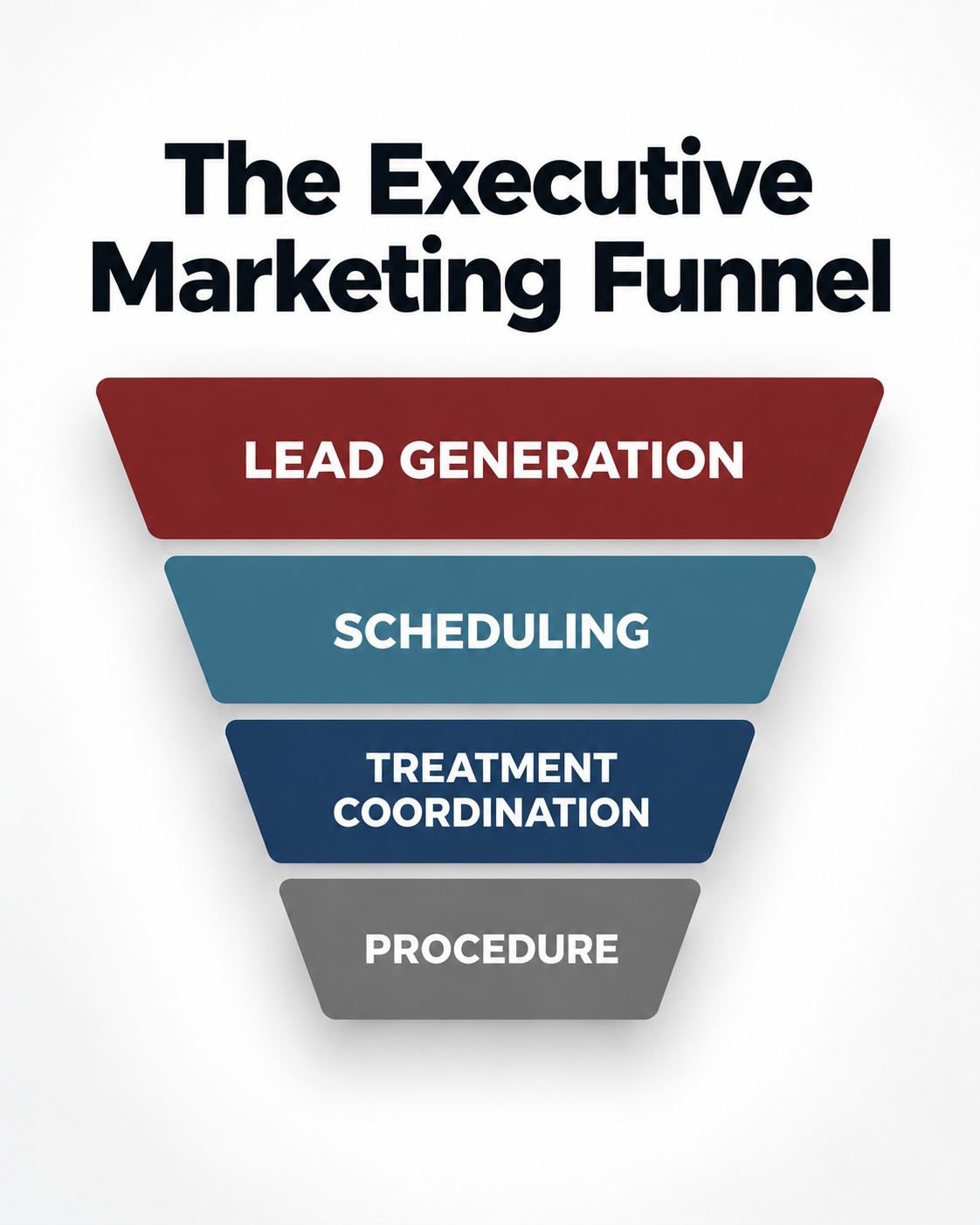
There are a lot of steps in a funnel. I've simplified it down to the four that get you the highest return. I start at the bottom, because that's where the highest return on investment is, and it sets the foundation for everything above it.
- The procedures you offer, and how you present them
- Treatment coordination
- Scheduling
- Lead generation
Step 1: The procedures you offer, and how you present them
A large DSO studied the new practices it was building. Some took off. Others stayed flat. They used large data sets and paid a big consulting firm to figure out why.
They already had a lot of the other things figured out. What made all the difference was the procedures each practice offered and how well those matched the community.
For them, it came down to one thing: getting patients out of pain. The practices that could take care of a patient who walked in hurting grew faster.
The practices that couldn't paid for it in word of mouth. A patient would come in hurting, leave without relief, and tell their neighbors something like, "Great dental practice, but they can't get you out of pain." That's the kind of word of mouth that quietly sends new patients somewhere else.
I'm not saying every practice needs to offer the same services. But whatever you offer needs to be high value to your community.
Then think about how you present it. With AI, the old grayscale presentation can now be color-coded, so the patient can see what's healthy and where they need treatment. That feels much more objective to a patient. These tools are also getting so good that they take a lot of the mental load off the doctor, who can then focus on the patient a lot more.
We've seen a 20% lift for owners who get this part right and use a presentation tool that helps the patient understand. At DEO, the coaching community I lead for dental practice owners, we've negotiated discounts with these vendors through our Cost Savings Club.
Step 2: Treatment coordination
Picture this. A patient sees your marketing. They call in, talk to your front desk, find a time that works, come in, and sit in the chair. You build a whole treatment plan for them. And they say no.
That's a bunch of marketing dollars that either pay off or are completely lost. You lost all the operational cost of that visit, too.
So ask yourself: Do I have the skill sets? Do I have the scripting? Do I understand what gets people to say yes to treatment I already know would help them get healthier? Or are they saying no because we don't have the language and the process for high treatment conversion?
You have a couple of choices here. You can wander in the wilderness trying to figure this out with your team, or you can find someone who already has the script and take it to the next level. At DEO, our Treatment Closing Academy is helping owners increase their yeses by 30%.
Step 3: Scheduling
The majority of dental practices answer the phone 60% of the time. That's been studied. If you don't know your number, assume that's yours.
Think about what that means. Out of 100 new leads, 40 never make it to your schedule. They don't even get answered. Right there, you can see you're spending twice as much on marketing as you need to.
Maybe it's the time they're calling. Maybe your team is too busy. Maybe it's the language being used on the phone, or how you've designed your schedule. There's so much opportunity right here in scheduling.
Step 4: Lead generation
At the top of the funnel, I don't think of it as marketing. I think of it as lead generation.
Your marketing firm isn't getting patients onto your schedule. They're not doing treatment coordination, and they're not choosing your procedures. Their job is simply getting the phone to ring, or getting a form filled out.
And speed matters. If someone fills out a form and you don't get back to them within five minutes, half of them are gone. They've already moved on to someone else.
We all do this. If I'm trying to book a restaurant or a massage and there's any friction, I'm back on Google finding the next one. Whoever has easy online scheduling, or gets back to me right away, is usually who I go with.
How much should every marketing dollar bring back?
When you put dollars into the top of the funnel, there's leakage at every step. By the time you get to the bottom, the dollars that make it out are so small that you think something's wrong with your marketing.
Here's the math I use. For every dollar I spend on marketing, I want $3 to make it to the bottom. If you're spending $1,000 on marketing, you should see an uplift of $3,000.
Why $3? About half of it goes to doctor pay, hygiene, supplies, lab, an assistant, and so on. That leaves $1.50. Let's assume you've already covered overhead, so that drops to the bottom line. Take out the $1 you spent on marketing, and you really made 50 cents.
That's the minimum profit I want off my marketing spend. If you want to see where the rest of your profitability comes from, start there.
Same marketing firm, 3.5x the results
Let's say one marketing firm works for two dental practices and generates 100 leads for each of them.
Practice A answers the phone 60% of the time, so 60 patients make it to the schedule. Practice B answers 90% of the time. Still not perfect, but good enough. They get 90 on the schedule.
Now treatment coordination. Practice A gets a yes 30% of the time. That's actually pretty decent. I think most dental practices are even worse. That's 18 patients saying yes.
Practice B is crushing it at 70%. If you can get above 60%, you're doing great. That's 63 patients saying yes.
To keep it simple, I'm giving both practices full marks on procedures.
Same firm. Same 100 leads. Practice B has three and a half times as many patients saying yes because it fixed its funnel.
Now say both practices are spending $5,000 on marketing. Practice A is spending $277 for every patient who says yes. That actually wouldn't be terrible. Practice B is spending $79.
That means Practice B has room to spend three times as much, generate more leads, and drive more to the bottom line as profit. With a great funnel, marketing becomes an investment game.
For a lot of you, you're not even sure what these numbers are in your practice. I'd get those nailed down first. Then I'd get the scripting, the improvements, and the processes in place.
Should you switch marketing firms?
If you feel stuck in a cycle with your marketing firm, hopefully now you know why. You keep pushing the firm to get more treatment, hoping patients will somehow cross the chasm to a yes.
Switching marketing firms over and over, hoping the next one gets patients to treatment, is a no-win game.
Instead, look at where you're at today and use the executive funnel. Organize yourself around these four areas and ask, "Which one do I want to fix next?" That's how you drive three times the profitability into your practice.
What to do this week
Start with scheduling. Taking on new procedures is a heavy lift and takes time. Treatment coordination is a skill set that takes a minute to build. Scheduling is the low-hanging fruit.
This week, find out your phone answer rate. Then look at the scripting your team uses on new patient calls, and get training there. If you don't know your number, assume it's 60% and start fixing it.
This is part of what we call revenue max: getting the most out of the patients and leads you already have before you spend more to get new ones.
Frequently asked questions
Should I switch dental marketing companies if I'm not getting results?
Not until you've looked at your funnel. Your marketing firm's job is to get the phone to ring. If calls go unanswered or patients say no to treatment, a new firm won't fix that.
What's a good phone answer rate for a dental practice?
Most dental practices answer the phone about 60% of the time. In my example, the practice answering 90% of the time still isn't perfect, but it's good enough to put 50% more patients on the schedule from the same leads.
What's a good treatment acceptance rate?
A 30% yes rate is actually pretty decent, and most practices are even worse. If you can get above 60%, you're doing great.
How fast should my team respond to a new patient form?
Within five minutes. After that, half of those leads are gone, because they've already moved on to the next practice on Google.
How much should my dental marketing bring back?
For every $1 you spend on marketing, you want $3 to make it to the bottom of the funnel. About half goes to doctor pay, hygiene, supplies, and lab, which leaves 50 cents of profit after the marketing spend. That's the minimum.
Want help fixing your marketing funnel?
If this is something you're ready to work on, schedule a Growth Accelerator Call with one of our DEO team members. We'll help you analyze your numbers, see which processes and vendors would help most, and see if DEO is the right fit for you.
As a member, you get access to our Cost Savings Club with discounted pricing on these vendors, an executive coach who meets with you on a regular basis, and a community of 700+ owners working on this right alongside you.
Adapted from Emmet's YouTube video, Before You Blame Marketing, Fix THIS in Your Dental Practice.

Share this post