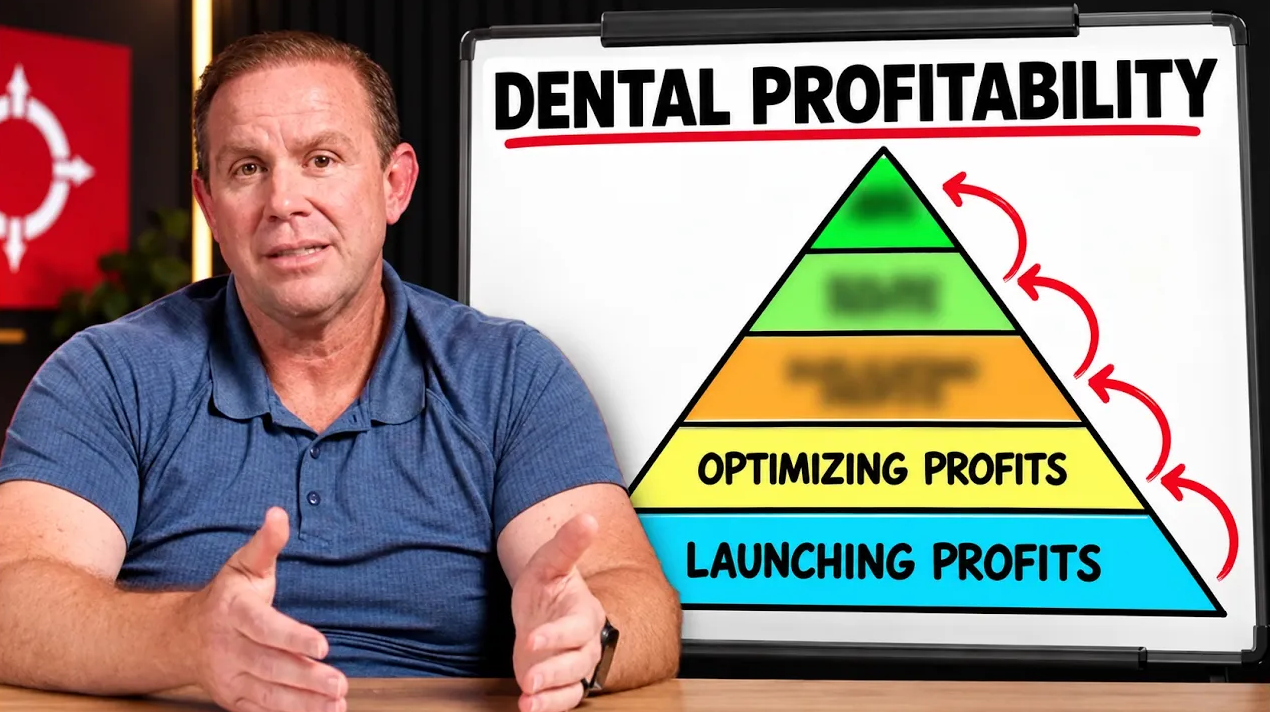
Most dentist owners believe that if they provide great clinical care and keep doing more procedures and more revenue, it all works out. It just doesn't.
We coach dental groups doing $10 million and up that still aren't at 20% profitability. More revenue didn't fix it for them, and it won't fix it for you either.
What fixes it is knowing which of the 5 profitability stages you're in. Once you see your stage, you'll know exactly which problem you need to solve.
Prefer to watch? Here's the full video.
The quick answer
To increase profitability in your dental practice, first figure out which of the 5 profitability stages you're in: Launching, Optimization, Duplication, Scaling, or Passive Profits. Each stage has one main problem to solve. When you stay focused on your stage's problem instead of chasing every idea at once, you can double your profits.
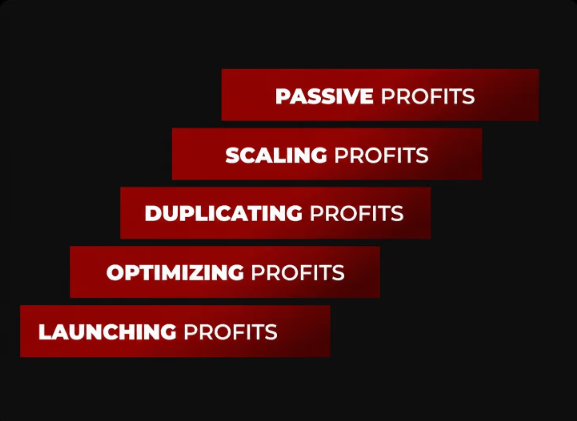
Stage 1: Launching Profits
All of us start at the bottom as entrepreneurs, and that's the launching profits stage.
Any time you launch something new, you're here. Opening a practice. Adding a specialty. Rolling out any new idea. And what's universal is that you're not making any money yet.
Your goal is simple: get more patients in the door and get to break even as fast as you can.
What keeps dental practices stuck at break even?
You're trying to do too many things at once. You think the number of locations matters most. You're trying to add a specialty, drop insurance, and add another provider all at the same time. That's too many moving parts, and it's burning your cash flow.
We worked with a practice owner who was trying to change their practice management software, add an associate, and add ortho. Once we dug in, the most important thing was clear: improve their collections. They did that, and it gave them the cash flow to start doing the other things.
Most entrepreneurs are successful because of the number of ideas they have in their head. At this stage, that can work against you. Choose one, maybe two ideas with the highest return, and hyperfocus on them until you hit break even.
Stage 2: Optimization
You've made it past break even, but you're still not at 20% profitability. Welcome to optimization.
This is the stage where dentists who thought "if I just take care of my patients and do more revenue, everything will work out" find out it doesn't. Your goal here is to find where profit is leaking out of your financial statements.
What overhead percentages should a dental practice have?
Here are the benchmarks I look at to hit 20% profitability:
It's not like you'll go bankrupt if one of these is at 7 or 8%. This is just math. Every point over the benchmark eats into your 20%.
Facility is the first place I look. For every $6,000 you spend on lease and utilities, you need to be doing $100,000 a month in production or collections. So if you've got a $12,000 lease, you need to be doing $200,000 every month.
Supplies are an easy win. When we see someone at 8% or 12% just in supplies, getting that down to 4% is all profit for them.
Non-clinical labor is the leak I see almost everywhere. A lot of practices that come into DEO are at 27 or 30%, and that goes straight out of the bottom line. You thought doing a lot of revenue would cover it, but rising labor costs are catching up with you.
Why your net income looks better than your cash flow feels
A lot of dentists are S corps taking distributions instead of paying themselves a full dentist's wage. So their net income looks better than it is, but they don't feel it in their cash flow.
Run your numbers as if you were paying yourself like an associate. You'll get a lot more clarity on whether you're really hitting 20%, and which benchmark you need to fix next.
One note for larger dental groups: once you add middle management, regionals, or a marketing director, expect net profitability closer to 15% instead of 20%.
Stage 3: Duplication
The next stage often helps you finish optimizing. We call it duplication, because you're duplicating your profits.
This isn't about adding another location. It's about adding another clinician, an associate or a hygienist, so you duplicate your revenue inside the same four walls.
One of our sayings at DEO: two doctors make more money than two locations.
The math on adding a second doctor
Say you're doctor number one, doing $100,000 a month. You're already covering all the overhead: rent, front desk, office manager, all of it.
Now you bring in doctor number two. Let's say that doctor isn't nearly as good as you and does $40,000 a month. After paying the doctor, hygiene, supplies, and lab, about half of that drops straight to the bottom line.
Half of $40,000 is $20,000 a month. That's about a quarter million a year in profit, and it's what gets most practices to 20% and doubles their profitability.
How do I get out of the chair?
This is one of the most common questions we get at DEO. Duplication is how you get out of the chair. Adding a second or third doctor builds profits that don't depend on you being the one producing.
Stage 4: Scaling
Eventually you'll run out of space in your facility. That's when you open another practice, and that's what we call scaling profits.
The thing you have to be careful of here: it needs to be copy and paste. If you've done an In-N-Out Burger, don't go do a Pizza Hut.
You need to understand what type of patients you take care of and what your model really is. Too often, people join DEO with three or four locations that are really a hodgepodge. It's a bunch of launching-stage practices, and they tell me all the time, "I was making more money with one or two locations than I am now."
Each new location is your new In-N-Out Burger. Keep your model, know which patients you're going to take care of, and expect to work back through the stages. You'll need to optimize again: facility cost, non-clinical labor, marketing spend. Then duplicate and fill that facility.
If you get ahead of yourself, you'll drop into what I call the launching trap. You're doing too many things at once, chasing too many ideas, and you've lost the first principle of staying focused until you hit profitability.
Don't get bored while you scale
Scaling takes a lot of operational energy, and it's easy for entrepreneurs to get bored. They think, "Been there, done that, let's go," and then things start to fall apart.
Keep building standard operating procedures. Get your org chart in place and make sure you have the team to support growth. Scaling is the time to be operationally grounded, not to come up with new ideas all the time.
Stage 5: Passive Profits
This is what every entrepreneur is trying to get to.
It doesn't mean you're sitting on the beach doing nothing. That's not in most of our natures. It means you can retire from the things you don't want to do anymore in your business.
You've optimized, you've duplicated, you've scaled, and behind the scenes you've been building profit that supports your lifestyle. Now you get to focus on the work you're most interested in.
At this stage, your decisions are about the executive team you want around you and what your next vision is. A lot of dentists get stuck once they actually hit their vision, so take time to ask yourself, "What do I really want to do next?"
Does this change if I want to sell my practice someday?
No. Whether you want to sell one day or keep a lifestyle business that gives you cash flow, the answer is the same. You're trying to build a great business.
And a great business that doesn't depend on you is the one you'll be able to exit for the highest multiple in the future.
The painful truth
Most dentist owners are only making 7% more than an associate dentist.
That's why following these stages matters. They're how you make sure you're actually doubling your profits.
What to do this week
Pull your most recent P&L. On paper, pay yourself what you'd pay an associate. Then compare each expense to the benchmarks above: facility, clinical labor, supplies and labs, non-clinical labor, and marketing.
Find the one that's furthest from its target. That's the leak taking the biggest bite out of your 20%, and it's the one to focus on first.
FAQ
What profit margin should a dental practice have?
Aim for 20% net profitability. Larger dental groups with middle management, regionals, or a marketing director should expect closer to 15%.
How much should a dental practice spend on rent?
Your lease and utilities should be about 6% of collections. That means every $6,000 in facility cost needs $100,000 a month in production or collections to support it.
Should I add an associate or open a second location first?
Add the associate first. Two doctors make more money than two locations, because the second doctor's production lands on overhead you're already paying. A second location starts you over with a whole new set of overhead.
How do I get out of the chair as a practice owner?
Through duplication. Bringing on a second or third doctor builds profits that don't depend on you producing, which gives you the freedom to start working on what's next.
Why am I making less money after opening more locations?
Usually because the locations don't follow the same model. When each practice is different, you end up running several launching-stage practices at once. Make each new location a copy of what already works, then optimize and duplicate it before opening the next one.
Watch the full breakdown
If you want to see exactly which stage you're in and what to fix next, watch the full video. I walk through every stage, every benchmark, and the math behind adding a second doctor.
Watch the full video on YouTube
I'm also releasing a lot of the material DEO members typically pay for on my YouTube channel. Subscribe here so you don't miss it.

Share this post
You might also like


3 Ways Automation and AI Help Dental Owners Reduce Admin Overload
